Tuesday, January 9, 2018

Blog 5. "The Killers." "You Better Not Think About It."

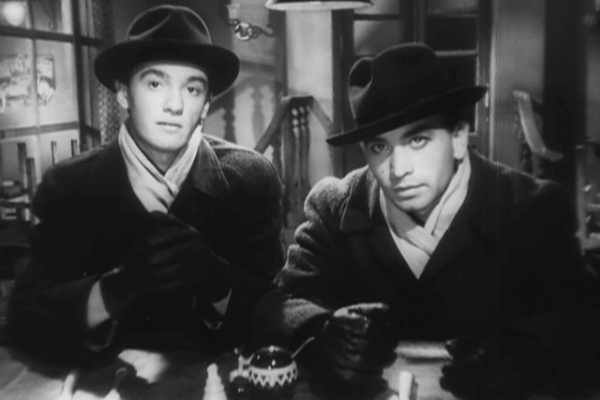
In their tight coats and derby hats they looked like a vaudeville team. (65)

Nick stood up.  He had never had a towel in his mouth before. (65)

"Little boys always know what they want to do," [the cook] said. (66)

Here's a clip of the opening of the story from the 1946 adaptation of it.  It was made again in 1964.  "The Killers" is considered by critics as one of Hemingway's greatest stories and one of the greatest American stories ever.  Originally published in 1927 and appearing in Hemingwayt's second short story collection Men Without Women, it is much anthologized and it is actually widely taught (along with "Hills Like White Elephants," "Soldier's Home," and "The Short Happy Life of Francis Macomber").  Some critics have thought it influenced absurdist and existentialist writers like Samuel Beckett and particularly his classic Waiting for Godot. Some consider it an existential comedy.  Not much happens in this story—but we've been saying that about every story.  Nick is older than he was in "Ten Indians," but not much older.  Why is he is this little town Summit, Illinois?  We don't know and that's important.  What did Ole Andreson do to get him on the hit list of these two gangsters?  We don't know.  We do know what George says in the face of the horror the story presents: "You better not think about it."

1. Your reaction?  And why?  What line or moment or image stuck with you from this story—and why?  Quote in your answer, ok?

2. We said today in class about "The Battler" that it seemed like a "Twilight Zone" episode. A horror story, in other words.  Do you feel anything similar about this story?  If so, how so?  If not, how would you describe the genre, or type, that this story belongs to to a friend?  And why?

3.  In fact, what is this story about to you?  Don't repeat the plot, but think about the theme or themes it develops for you.

4. What does Nick learn here?

5.  Ole Andreson: many critics consider him a hero—as much as one can be a hero in a Hemingway story.  Yes?  No?  Why?

That's more than enough.  Al and Max have been compared, as I wrote above, to characters in Waiting for Godot, Valdimir and Estragon, forever waiting for...Godot, who never appears in the play. Here they are:


Here, from a film version of "The Killers" made by the Russian filmmaker Sergei Tarkovsky:

Monday, January 8, 2018

Blog 4. "The Battler." "They Would Never Suck Him In That Way Again." (11th and 12th graders)

"...Listen, you ever get been crazy?"
"No," Nick said. "How does it get you?"
"I don't know," Ad said.  "When you get it you don't know about it."

This is a trailer for the film adaptation of the stories you're reading, Hemingay's Adventures of A Young Man, released in 1962—the year your book was published, and the year after Hemingway died of a self-inflicted gunshot.  The movie wasn't very successful.  Fast forward to the end and you'll see Paul Newman as Ad Francis, The Battler.


Nick is a few years older from where we saw him in "Ten Indians," now riding the rails by himself in upper Michigan.  And out in the middle of nowhere, he experiences...

1.  Your reaction to the story?  Like?  Dislike?  What stayed with you after reading it?  Quote from it in your response.

2.  "And out in the middle of nowhere, [Nick] experiences...."  What does he experience—in one word. And then explain why that word.

3. I would argue that Nick, cut loose from the ties of community and family, now begins to really see the way the world works—and his unpreparedness for what's out there.  Agree or disagree with that statement.  Explain your answer.

4.  Ad and Bugs: a love story.  Yes or no?  And why?

A map of the region of Michigan where these stories take place:


Sunday, January 7, 2018

Blog 3. "Ten Indians." "My Heart's Broken."

 17 year old Ernest Hemingway.


Hem and his family, upper Michigan.


"Have some more." His father picked up the knife to cut the pie.
"No," said Nick.
"You better have another piece."
"No, I don't want any."

"Ten Indians" finds Nick older than he was in "Indian Camp" and "The Doctor and Doctor's Wife."  It appears to be a story of young Nick's first broken heart when he hears about his "girl" Prudie "having quite a time" with Frank Washburn, the bad news delivered to him by his father while feeding him a big piece of huckleberry pie.  It's a classic coming-of-age narrative; but Hemingway turns in into something else as well.

1. Your reaction to the story?  Like? Dislike?  Why?  And what about it stuck with you, stayed with you—and why? Go ahead and quote from the story.

2.  Even before the end of the story and Nick's "broken heart," we know everything is not wonderful on this Fourth of July, even as Nick and the Garners come home happy from the festivities.  What plays against the general air of gaiety in the story?

3.  Doc Adams: he is the crux of this story.  Is he doing the right thing by telling Nick about Prudence?  Is he looking out for his son—or is possibly something else motivating him?  What do you think?

In answering these, keep your answers separate, okay?  Do 1. Do 2.  Do 3.  Hope you all had a good weekend.

Just for fun.  A Hemingway cat at The Hemingway House in Key West, Florida.


Thursday, January 4, 2018

Blog 2. "The Doctor and Doctor's Wife." "'I Want To Go With You,' Nick said."

The Hemingways: Marcelline, Sunny, Clarence, Grace (Mrs. Hemingway), Ursula, Ernest.


"The Doctor and Doctor's Wife" first appeared in In Our Time.  It is barely, in certain ways, a Nick Adams' story: little Nick appears only at the end.  As many of the Nick Adams stories are, it is very autobiographical. 

The Hemingways, in Ernest's youth, summered in upper Michigan, where this story and "Indian Camp" take place. Clarence Hemingway was, like Henry Adams, a doctor; Grace Hemingway, like Mrs. Adams, a Christian Scientist, which, according to the oracle, Wikipedia, means:

Eddy described Christian Science as a return to "primitive Christianity and its lost element of healing." There are key differences between Christian Science theology and that of other branches of Christianity. In particular, adherents subscribe to a radical form of philosophical idealism, believing that reality is purely spiritual and the material world an illusion. This includes the view that disease is a mental error rather than physical disorder, and that the sick should be treated not by medicine, but by a form of prayer that seeks to correct the beliefs responsible for the illusion of ill health.

The church does not require that Christian Scientists avoid all medical care—adherents use dentists, optometrists, obstetricians, physicians for broken bones, and vaccination when required by law—but maintains that Christian-Science prayer is most effective when not combined with medicine. Between the 1880s and 1990s, the avoidance of medical treatment led to the deaths of several adherents and their children. Parents and others were prosecuted for, and in a few cases convicted of, manslaughter or neglect.

1. Everyone: Your reaction to the storyWhat particularly struck you, or stayed with you, about it? Quote once in your response.
 
2.  9th and 10th graders: If someone in anther class asked you what this story was about, what would you say?  Don't simply say, it's about a doctor and his wife: but think about what this is telling us about Henry Adams, the protagonist of it—it's his story, really. 

2. 11th and 12th graders only: Today in class, I think it was Emma—Jones—who asked the question of why does Doctor Adams respond to Nick's query of "'Do many women [kill themselves]?'" with "'Hardly ever.'" I said to Emma that this story might answer the question.  So: how does this story answer Emma's question? Or: how does it give some explanation or context for the way Doctor Adams behaves in "Indian Camp"?

3. Everyone: this is Henry's—and his wife's—story.  But Hemingway does put Nick in at the end.  Why?  What do you see is the purpose of having little Nick—"sitting with his back against the tree, reading"—in the story?  Or: if we read the stories in this collection as moments of initiation for Nick—as moments which will help shape him into the adult he will become—how does this story function in that context?

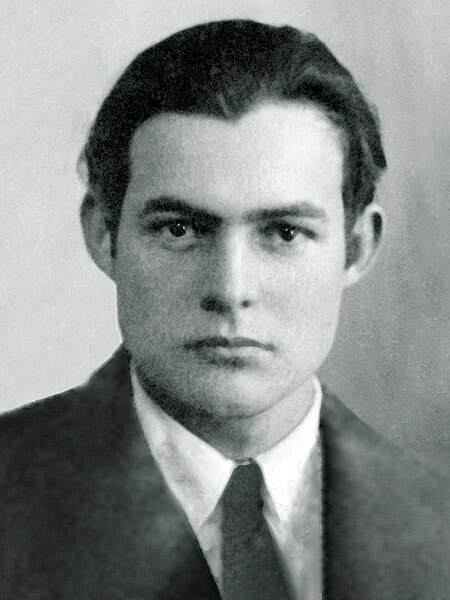
200 words, just like last night.  Below: Hemingway's passport photo on his way to Paris, where he will write In Our Time.


Wednesday, January 3, 2018

Blog 1. "Indian Camp." "But Her Screams Are Not Important. I Don't Hear Them Because They Are Not Important."

"Indian Camp" is the first story in Hemingway's first major work In Our Time, published in 1925 when he was all of 26 years old.  It was a critical success. As the reviewer in The New York Times wrote:

Mr. Hemingway packs a whole character into a phrase, an entire situation into a sentence or two. He makes each word count three or four ways. The covers of his book should strain and bulge with the healthful ferment that is between them. Here is an authentic energy and propulsive force which is contained in an almost primitive isolation of images as if the language itself were being made over in its early directness of metaphor. Each story, indeed, is a sort of expanded metaphor, conveying a far larger implication than its literal significations. 

Critics—and readers—picked up on what you said in class today: the way Hemingway writes as if for a sixth grade test, the way each word takes on greater meaning because of the scarcity of words in the writing, the way he "packs a whole character into a phrase, an entire situation into a sentence or two."  And in this story he introduces us to Nick, his father, and the universe they inhabit—which he will develop as he keeps writing about Nick.  So:

1. Everyone respond: your reaction to the story?  Like?  Dislike?  Why?  And what line or sentence or image stays with you after you've set the story down?  Quote from the story.

2.  9th and 11th graders: what is your impression of Doctor Adams?  Is he good father?  A bad father?  Explain.

2. 10th and 12th graders.  This is generally seen as an initiation story.  How so?  And what does Nick do with his new knowledge? 

3.  Everyone: does this story  have a happy ending?  Why or why not?

Write about 200-250 words in response to the three questions. Enter your response in the comment link at the end of the blog post.

A young Ernest Hemingway:


And the first edition of In Our Time: